

Airtightness Testing
Measure air leakage and understand how your building really performs
Airtightness testing (blower door testing) provides a quantifiable measure of uncontrolled air leakage through the building envelope.
Air leakage can be a major source of heat loss and energy waste. Testing provides clear data and helps identify where conditioned air is escaping or outside air is entering the building.
Why Airtightness Matters
Uncontrolled air leakage can result in:
Uncontrolled heat loss in winter and heat gain in summer
Higher heating and cooling costs
Draughts and uneven indoor temperatures
Reduces effectiveness of insulation
Increased risk of condensation and moisture issues
What Is Blower Door Testing?
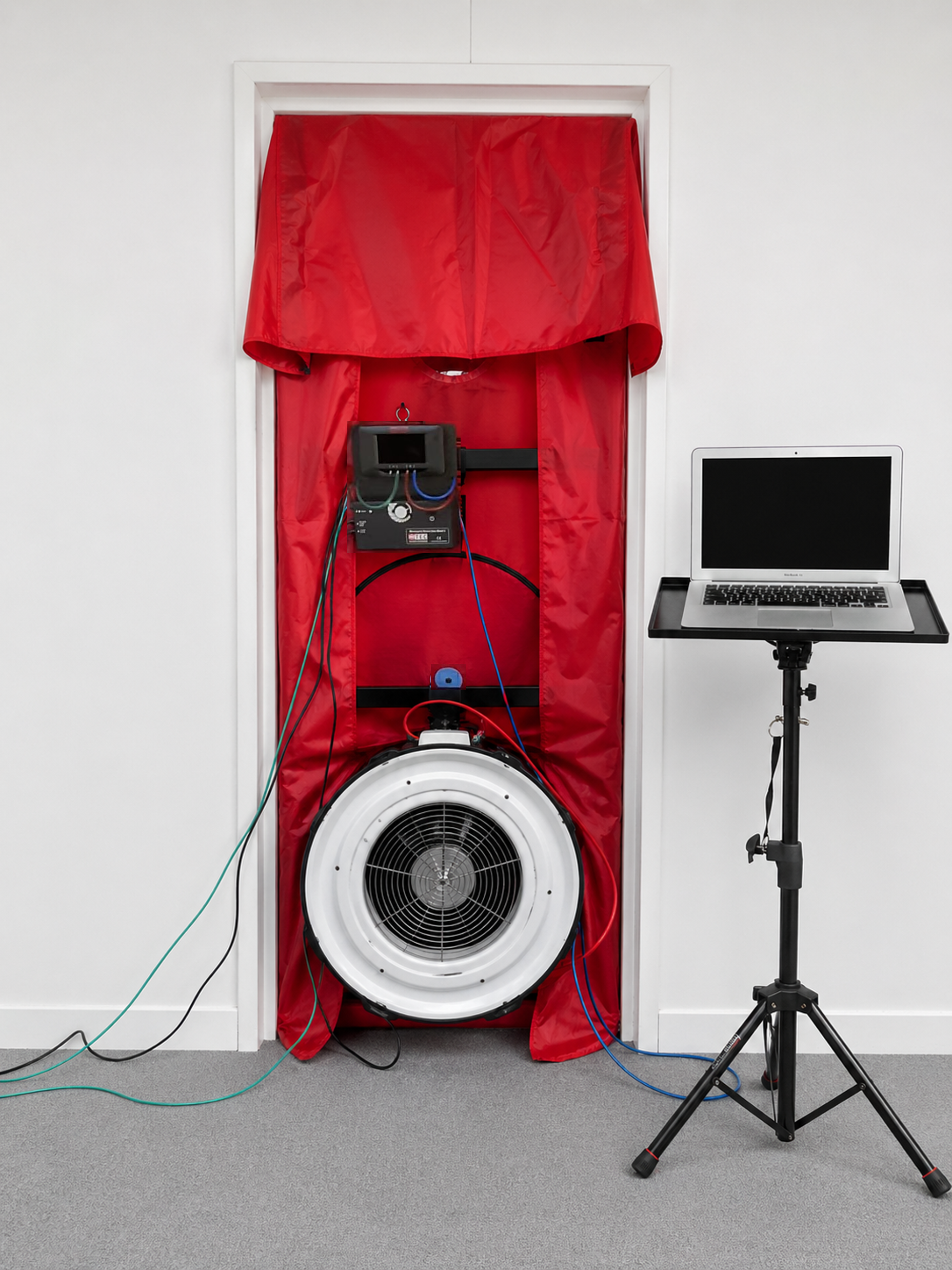
A calibrated fan is temporarily installed in an external opening to create a controlled pressure difference between inside and outside.
By measuring the airflow required to maintain this pressure, the air leakage rate of the building is determined.
This allows performance to be :
Measured
Compared against targets or standards
Documented for verification
Air Leakage Detection
During testing, air leakage pathways can be identified using:
Smoke visualisation
Air movement detection tools
Thermal imaging (when conditions allow)
Blower Door Testing with Thermal Imaging
When suitable temperature differences exist, thermal imaging can be used during blower door testing to help visualise air movement.
Under suitable conditions, incoming and outgoing air can create detectable surface temperature variations, making some leakage pathways easier to identify.
This approach is particularly useful when:
Investigating draughts or occupant comfort issues
Locating less obvious or distributed leakage paths
Working on complex building assemblies
What Airtightness Test Does Not Cover
Airtightness testing measures the air leakage rate of the building envelope. It does not assess:
Insulation performance
Structural condition
Moisture damage or mould
Acoustic or fire performance
Who It’s For
Builders and contractors – Quality assurance and defect risk reduction
Architects and designers – verification of design intent
Homeowners – investigation of draughts and comfort concerns
Certifiers and consultants – compliance and performance verification
When to Test
During construction (recommended for early issue detection and easier rectification)
At completion (for performance documentation)
When investigating existing building performance issues
What You Receive
A measured airtightness result (e.g. ACH)
Identification of air leakage pathways during testing
Observations to inform further investigation and remediation by qualified professionals